From hidden chemistry to informed decisions.

No company should be blindsided by the chemistry in its own products.

Our vision

A world where companies turn materials intelligence into strategic advantage, moving faster and with more certainty than their competition.

ChematIQs turns chemistry into business decisions. We build AI that understands materials at the molecular level, so companies can find out what's really in their products, catch risks before they become liabilities, and choose materials that are easier to source and sell.

The problem

Regulations target molecular structures. Supply chains hide them.

Every product is built from chemicals its manufacturer can't fully see. Parts, components and formulations pass through long supply chains, suppliers keep chemistry behind proprietary names, and the documents that arrive are inconsistent and incomplete.

Available information
  1. Chemical producer6:2 fluorotelomer acrylate · CAS 17527-29-6
  2. FormulatorAquaShield DWR-6 trade name
  3. Component supplierWater-repellent finish proprietary · 1–5 %
  4. Your productRain jacketDoes it contain PFAS?Can we still sell it in Europe?Do we need to replace it?
Regulation by structure 24M

EU: the proposed universal PFAS restriction uses the OECD definition, which covers an estimated 24 million chemical structures.

US: 22+ states define PFAS as any substance with at least one fully fluorinated carbon, and some already require disclosure in all consumer products.

Litigation $14B+

in PFAS settlements so far, with more than 15,000 lawsuits consolidated in US federal court.

Claims have moved down the supply chain, from chemical producers to consumer brands and everyday products.

Supply shocks 3–4 years

to bring a non-PFAS chip material into volume manufacturing, even when an alternative exists.

When 3M exited PFAS manufacturing, makers of medical devices, chips and aerospace wiring had to requalify. A rushed substitute can become the next regrettable substitution.

What we do

Safer Materials Advisor answers in minutes what took teams months, and finds what they never could.

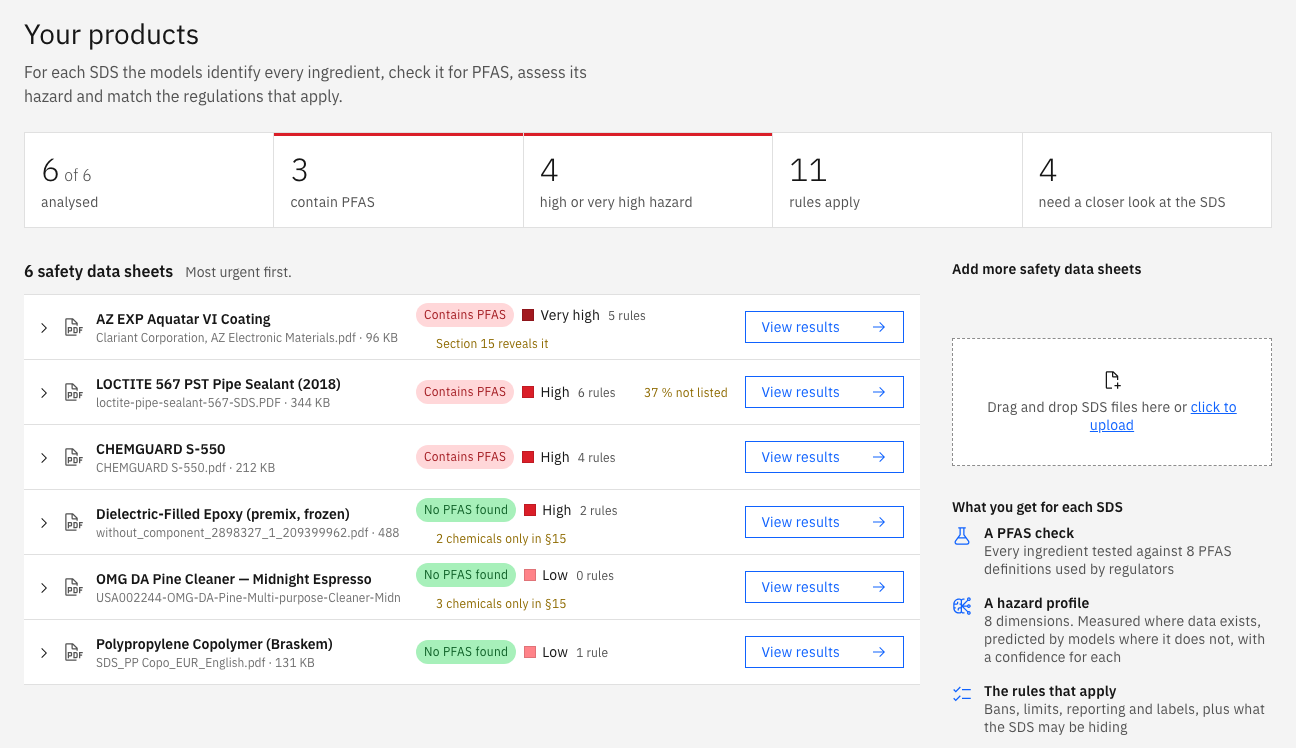
Add your supplier documents and get a risk-scored portfolio. Every result shows its reasoning and sources, so your experts can review the evidence.

  1. What is in my products? The chemistries inside, including ones suppliers don't disclose. Consistency checks flag ingredients that are missing or disguised.
  2. How are they regulated? Across jurisdictions and use cases, including rules defined by structure and chemical class.
  3. How hazardous are they? Measured data where it exists, AI predictions for untested and novel substances.
  4. What should replace them? Safer alternatives that meet performance requirements and avoid regrettable substitutions.
Safer Materials Advisor portfolio view: six screened safety data sheets, sorted by urgency, with PFAS status, highest hazard and the number of rules that apply
Portfolio view with sample dataSee how it works →

Roadmap

Reveal. Replace. Rebuild. Reimagine.

Every material raises four questions over its life. We answer the first two today, and the same chemistry foundation carries us through the rest.

  1. Safer Materials Advisor · In production

    Reveal

    What's in your products, and what does it expose you to?

    For compliance and EHS

  2. Materials Strategy Advisor · From 2029

    Rebuild

    How should your materials be sourced and made, at lower cost and with less supply risk?

    For procurement and operations

  3. Materials Strategy Advisor · From 2029

    Reimagine

    What happens to your materials after use, and how do you recover their value?

    For product strategy and sustainability

See what Safer Materials Advisor finds in your supplier documents.

Bring a product and its safety data sheets, and we'll walk you through the results.

[email protected]